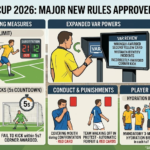




The FIFA World Cup, soccer’s most prestigious international tournament, is always evolving. For fans and players alike, understanding the recent changes to its rules and structure is crucial. In essence, the biggest news revolves around an expanded tournament format, a more ingrained role for VAR, and tweaks to how tie-breakers are handled. These aren’t just minor adjustments; they significantly impact everything from team strategies to host country logistics.
The Bigger Picture: Expanded Tournament Format
The most impactful change to the FIFA World Cup is undoubtedly its expansion. We’re moving beyond the familiar 32-team setup, and this shift brings a ripple effect across the entire tournament.
What it Means for Teams and Fans
Starting with the 2026 World Cup, we’ll see a substantial increase in participating nations. This expansion opens the door for more countries to experience the thrill of the World Cup, something many smaller nations have long campaigned for. For teams, it means a slightly easier path through qualifying rounds in some regions, as more spots are available. For fans, it means even more games to watch, and potentially more underdog stories unfolding on the world stage. The tournament will undoubtedly feel larger, both in scope and duration.
How it Impacts the Schedule and Logistics
The increase from 32 to 48 teams isn’t just a simple addition of 16 more squads. It necessitates a complete overhaul of the tournament structure. Instead of eight groups of four, we’ll see 12 groups of four teams, or potentially 16 groups of three. While the exact format for the group stage is still being finalized, the overall implications are clear: more matches will be played, extending the tournament’s length. This puts immense pressure on host nations to provide more venues, training facilities, and accommodate a larger number of teams and their support staff, not to mention the influx of more fans. The logistical challenges are significantly amplified, driving the need for multi-national hosting bids, which we are already seeing for 2026.
The Knockout Stage Evolution
With more teams making it past the group stage, the knockout rounds will also expand. Instead of a straightforward Round of 16, we’ll likely see an additional round introduced, potentially a Round of 32. This means teams will need to endure more matches to reach the final, testing their endurance and squad depth even further. For viewers, it guarantees more high-stakes football, but it also increases the overall workload for players, raising concerns about player welfare and potential burnout.



Technology Taking Center Stage: VAR Implementation
Video Assistant Referee (VAR) technology, while not entirely new to football, has become a more permanent and refined fixture in the World Cup. Its widespread and standardized implementation is a significant step, aiming for more consistent and fair decision-making.
How VAR Works in Practice
VAR involves a team of video assistant referees who review decisions made by the on-field referee using footage from multiple camera angles. They primarily intervene in “clear and obvious errors” or “serious missed incidents” in four key match-changing situations: goals (and offenses leading to them), penalty incidents, direct red card incidents, and mistaken identity in awarding cards. The on-field referee can then use a pitch-side monitor to review the incident themselves, or accept the VAR’s recommendation. The goal is to minimize incorrect calls that could significantly alter the outcome of a match.
The Impact on Game Flow and Fan Experience
VAR has undeniably introduced a new dynamic to the game. While it aims for accuracy, it often leads to delays as incidents are reviewed, which can interrupt the flow of play and test the patience of fans. There’s also the ongoing debate about the “subjectivity” within VAR calls, even with technology. Fans in stadiums sometimes feel disconnected from the review process, as visual cues of what’s being reviewed aren’t always immediately clear. However, many also appreciate the correction of previously game-altering errors, fostering a sense of greater fairness. It’s a trade-off, balancing accuracy with the traditional rhythm of football.
Future Enhancements: Semi-Automated Offside and Beyond
Looking ahead, we’re already seeing advancements like semi-automated offside technology, which uses limb-tracking cameras and a sensor in the match ball to provide quick and accurate offside decisions. This aims to reduce the time taken for offside VAR checks. FIFA is continuously exploring other technological aids, such as goal-line technology (which is already standard) and potential future applications to address other contentious areas of the game, though always with a careful eye on maintaining the human element and spirit of football.
Deciding the Undecided: New Penalty Shootout Format
Penalty shootouts have always been a tense and dramatic way to decide knockout matches that end in a draw. While the core concept remains, there have been considerations and even trials of new formats to potentially change the psychological dynamics.
The ABBA Format Experiment
One notable experimental change, though not universally adopted for the World Cup just yet, was the “ABBA” format. Instead of teams taking alternate penalties (AB AB AB), this format mimiced a tennis tie-break where Team A takes the first penalty, then Team B takes two (BB), then Team A takes two (AA), and so on. The idea behind this was to reduce the perceived pressure on the team taking the second penalty in the traditional format, as they are often chasing the score. Psychological studies suggested this might offer a more balanced pressure distribution.
Current World Cup Shootout Rules
For the World Cup, the traditional ABAB format for penalty shootouts remains the standard. Each team takes five penalties alternately. If scores are level after five penalties, the shootout goes to sudden death, where teams continue to take one penalty each until one team scores and the other misses. All eligible players, including the goalkeeper, must take a penalty before any player can take a second. This format, while dramatic, has been a staple of football for decades and has created countless iconic moments.
Keeping it Clean: Fair Play Regulations
Fair play has always been a cornerstone of football, and FIFA continually refines its regulations to ensure sportsmanship and respect on the field. These regulations often evolve to address new forms of unsportsmanlike conduct or to clarify existing rules.
Addressing Simulation and Diving
One area of continuous focus is on simulation and diving. Referees are increasingly empowered to penalize players who exaggerate contact or feign injury to gain an unfair advantage (e.g., winning a free kick or penalty). VAR also plays a crucial role here, allowing officials to review incidents where simulation is suspected and award appropriate sanctions, often a yellow card. The aim is to deter players from undermining the integrity of the game through deception.
Respect for Officials
Ensuring respect for match officials is another key component. Rules and guidelines are in place to penalize players or coaching staff who show dissent or act aggressively towards referees. This includes verbal abuse, inappropriate gestures, and physical contact. Stricter penalties are often applied for repeated offenses or particularly egregious behavior, aiming to protect the integrity of the officiating process and maintain a respectful environment on the pitch.
Tackling Discrimination and Racism
FIFA has a zero-tolerance policy towards discrimination and racism. Regulations are robust in penalizing any form of discriminatory behavior from players, officials, or fans. This can range from fines and stadium bans to point deductions or even expulsion from tournaments for severe and repeated offenses. There are also clear protocols for reporting such incidents and for match officials to follow if they witness or are informed of discriminatory behavior during a match, including potentially stopping or abandoning games in extreme circumstances.
Who Plays and Where: Eligibility and Hosting

The global nature of the World Cup means that rules around player eligibility and the process for selecting host nations are always under scrutiny, balancing national representation with sporting integrity and practical considerations.
Player Nationality Rules
FIFA’s rules regarding player eligibility revolve around nationality. Generally, a player must hold the nationality of the country they wish to represent. However, complexities arise when players hold multiple nationalities or have played for a youth national team of one country but wish to represent another at the senior level. FIFA has provisions for switching national allegiance under specific conditions, often requiring that the player has not played a competitive “A” match for their initial national association and meets residency requirements. These rules are designed to prevent players from “country shopping” purely for competitive advantage, while also allowing for genuine cases of dual nationality.
The Host Selection Process
The process for selecting World Cup hosts is extensive and highly competitive. It involves countries (or increasingly, multiple countries in joint bids) submitting detailed proposals outlining their infrastructure, transport, hotel capacity, security measures, and financial guarantees. FIFA evaluates these bids rigorously, assessing their ability to meet the tournament’s demands, their legacy plans, and how their hosting aligns with FIFA’s objectives. A voting process by the FIFA Council ultimately decides the host. Recent changes have emphasized human rights considerations and sustainability in the bidding criteria, moving beyond purely financial and infrastructural aspects to encourage responsible and impactful hosting.



Keeping a Level Playing Field: Financial Fair Play Regulations
While often more prominent in club football, the principles of financial fair play (FFP) do have an indirect influence on international football and World Cup preparations. The idea is to ensure financial stability and prevent overspending that could lead to financial instability.
Indirect Impact on National Associations
For national associations, while they aren’t directly subject to UEFA-style club FFP, their financial health is crucial for supporting their national teams. FIFA and continental confederations often provide grants and funding, but robust financial management within national FAs ensures they can properly invest in youth development, coaching infrastructure, and national team preparations. This indirectly affects a country’s ability to compete at the highest level, including the World Cup.
Ensuring Sustainable Hosting
Financial solvency is a critical component of host country selection. Bidding nations must demonstrate they have the financial capacity to build or upgrade stadiums, ensure security, and manage the massive logistical undertaking of hosting the World Cup without incurring unsustainable debt or diverting essential public funds. FIFA assesses the financial viability of bids to ensure the tournament doesn’t leave the host country in financial distress, promoting a more sustainable and responsible approach to major event hosting.
FAQs
What are the key changes in the new FIFA World Cup rules?
The key changes in the new FIFA World Cup rules include an expanded tournament format, implementation of VAR technology, a new penalty shootout format, fair play regulations, player eligibility and nationality rules, host country selection process, and financial fair play regulations.
What is the expanded tournament format?
The expanded tournament format for the FIFA World Cup will see an increase in the number of participating teams from 32 to 48, starting from the 2026 edition. This will involve an additional 16 teams competing in the tournament.
How will VAR technology be implemented in the FIFA World Cup?
VAR (Video Assistant Referee) technology will be implemented in the FIFA World Cup to assist match officials in making correct decisions during games. This technology will be used to review key incidents such as goals, penalty decisions, red card incidents, and cases of mistaken identity.
What is the new penalty shootout format?
The new penalty shootout format for the FIFA World Cup will see a change in the order of kicks, with the team taking the first kick in each pair of kicks in a shootout to be determined by a coin toss.
What are the fair play regulations in the new FIFA World Cup rules?
The fair play regulations in the new FIFA World Cup rules aim to promote sportsmanship and fair play among teams and players. This includes measures to address issues such as diving, time-wasting, and unsporting behavior.
What are the player eligibility and nationality rules in the new FIFA World Cup rules?
The player eligibility and nationality rules in the new FIFA World Cup rules outline the criteria for players to represent a national team, including rules on nationality, residency, and eligibility to switch national teams.
How is the host country selected for the FIFA World Cup?
The host country for the FIFA World Cup is selected through a bidding process, where countries submit bids to FIFA to host the tournament. The selection process involves various criteria such as infrastructure, facilities, and financial considerations.
What are the financial fair play regulations in the new FIFA World Cup rules?
The financial fair play regulations in the new FIFA World Cup rules aim to ensure that participating teams and host countries adhere to financial regulations and guidelines to promote sustainability and fair competition. This includes measures to prevent financial misconduct and ensure transparency in financial dealings.