


RIP Tactical Time-Wasting: How Soccer’s New Rules Will Change the World Cup
We’ve all seen it, and we’ve all hated it. It’s the 87th minute of a massive match. A goalkeeper takes an eternity to adjust their socks before a goal kick. A fullback slowly meanders toward a throw-in, looking everywhere but at the ball.
Tactical time-wasting in soccer has long been accepted as a necessary evil—a dark art mastered by elite managers to close out games.
But according to the latest rule book updates from the International Football Association Board (IFAB), the dark arts are officially banned. Ahead of the tournament, football authorities are implementing radical countdown timers that will alter endgame management forever.
Here is a breakdown of how these rules will shatter traditional tactics and what teams must do to adapt.
The Death of the Corner-Flag Stumble
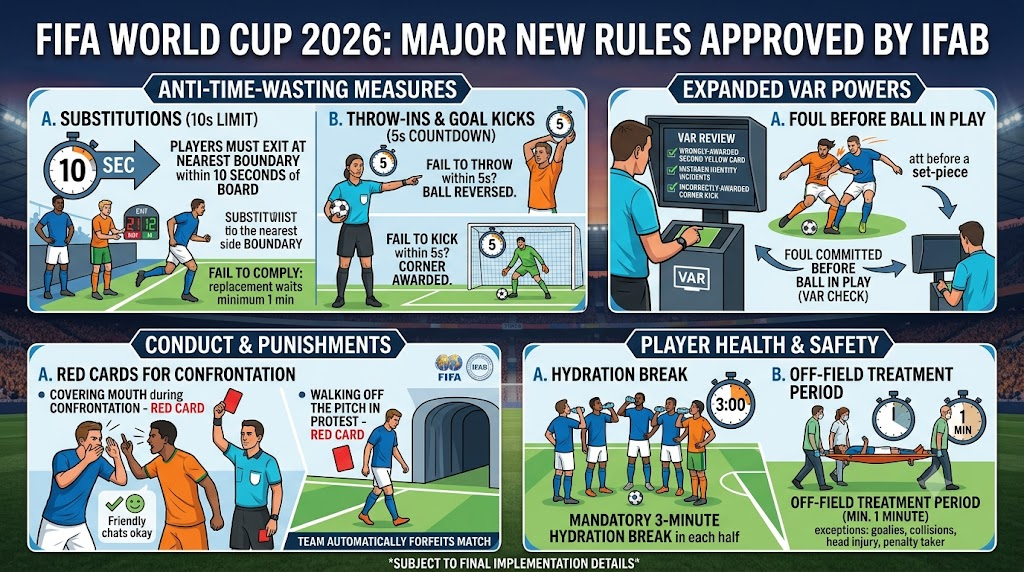
Historically, protecting a lead meant taking the ball to the opponent’s corner flag to run down the clock or taking a minute over a throw-in. The new goalkeeper 5-second rule and throw-in limitations completely destroy this slow-down philosophy.
If a team stalls for more than 5 seconds on a throw-in, they lose the ball. Even worse, if a keeper stalls on a goal kick, the opponent gets a corner kick.
The Tactical Shift:
Managers can no longer instruct their teams to “breathe” during resets. Goalkeepers will now have to prioritize rapid distribution over defensive shape setup. We are likely to see an increase in short, immediate goal kicks to avoid the risk of giving away a catastrophic set-piece. Defending teams will also press incredibly high during goal kicks, knowing that they only have to disrupt the keeper’s thought process for five seconds to earn a corner.



Subbing Off Under Pressure Just Became a Penalty
The late-game substitution used to be the ultimate time-killing weapon. A manager would sub off their star winger on the opposite side of the stadium, forcing them to take an agonizingly slow walk to the bench while checking their shinguards.
The new 10-second substitution rule eliminates this entirely:
[Electronic Board Goes Up] ---> 10 Seconds to Exit at Nearest Boundary ---> Fail? Team Plays 1 Man Down for 1 Minute
If a player fails to leave the pitch within 10 seconds of the board going up, their replacement is barred from entering the field until one full minute after play restarts.
The Tactical Shift:
Late-game substitutions will now require immense coordination. Outgoing players will literally have to sprint to the nearest touchline or goal line. If a player slips up or deliberately tests the referee, their team faces a brutal 60-second period where they must defend short-handed. Expect managers to heavily drill “exit routes” in training camps.
Final Thoughts: Adapt or Fail
These guidelines don’t just fine-tune soccer; they completely shift the logistical flow of a match. Teams that rely on breaking up the rhythm of a high-pressing opponent through slow restarts are going to get punished severely. The teams that thrive will be those with high fitness levels, fast-thinking keepers, and strict positional discipline during sudden transitions.
The era of the tactical stroll is over. Welcome to the era of the sprint.
Which team do you think will struggle the most with these high-speed rules? Sound off in the comments!